
This article was originally shared on our LinkedIn.
Using the 5S Method to Improve Efficiency at the Engineering Technology Centre
10 Aug 2026
Technicians in the Engineering Technology Centre (ETC) at Daresbury Laboratory have recently implemented Japanese manufacturing methodologies, improving efficiency and increasing focus on engineering work which will push scientific innovation.

Luke Bladen, Mechanical Technician and Lead Technician for the crab cavities project, who led the implementation of the 5S method at the ETC.
The ETC is a 60-year-old institution, offering multidisciplinary engineering solutions to complex problems, such as the recent crab cavity cryomodule assemblies, built as part of CERN’s High Luminosity upgrade to the Large Hadron Collider. Over the years, the ETC has undergone many improvements, as it adapts to host increasingly high-end projects.
Now, the Technology team, led by Luke Bladen, have streamlined systems further by implementing the 5S methodology – a practice that uses continual refinement to sustain organisation and ruthlessly cut away the ‘noise’ that clouds the true purpose of such a complex workspace.
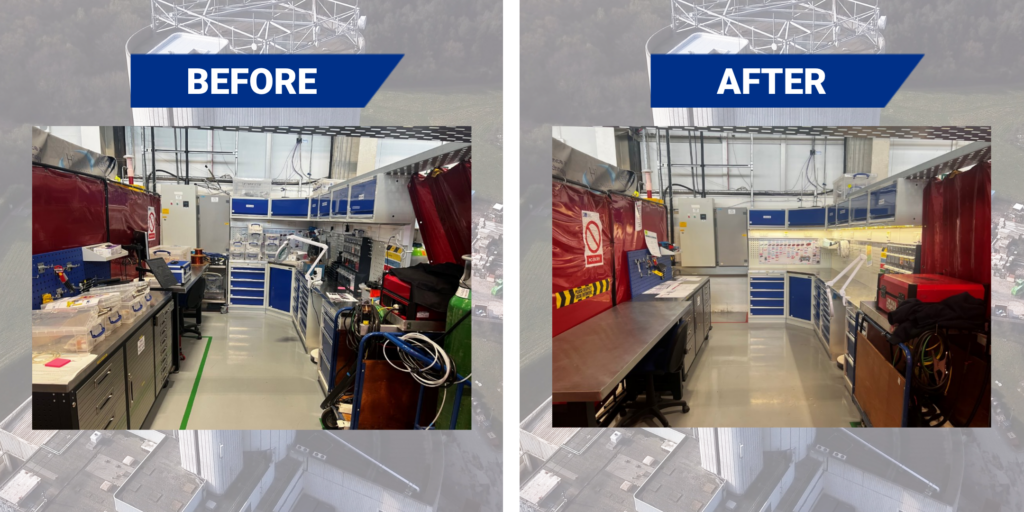
A bench workspace in the ETC before and after the implementation of 5S.
First developed in the 1950s in Japanese car companies, manufacturing practices, like the 5S method, have been acclaimed as the pinnacle of engineering operational efficiency. The 5 pillars are:
- Sort – Clearing all unnecessary clutter, leaving a blank space
- Set in order – Bringing just essentials back and giving everything a formalised ‘home’, taking their purpose into consideration
- Shine – Cleaning all items and the workspace
- Standardise – Establish consistent rules, so everyone understands the new system
- Sustain – Ensure standards don’t slip through continuous implementation
Implementing such a detailed system comes with many challenges. When asked about the main difficulty, Luke shared that,
‘Enacting a culture change is supremely difficult – having a very small and also young team open to dramatic change allowed for this success. When a space is so tidy, it can also incentivise others to adopt a similar standard through the black and white comparison.’
These changes have already led to noticeable improvements in efficiency, safety and production focus. When everything has its place, no time is wasted in searching for components or re-cleaning items, allowing everyone to focus on the real challenge – the engineering itself.
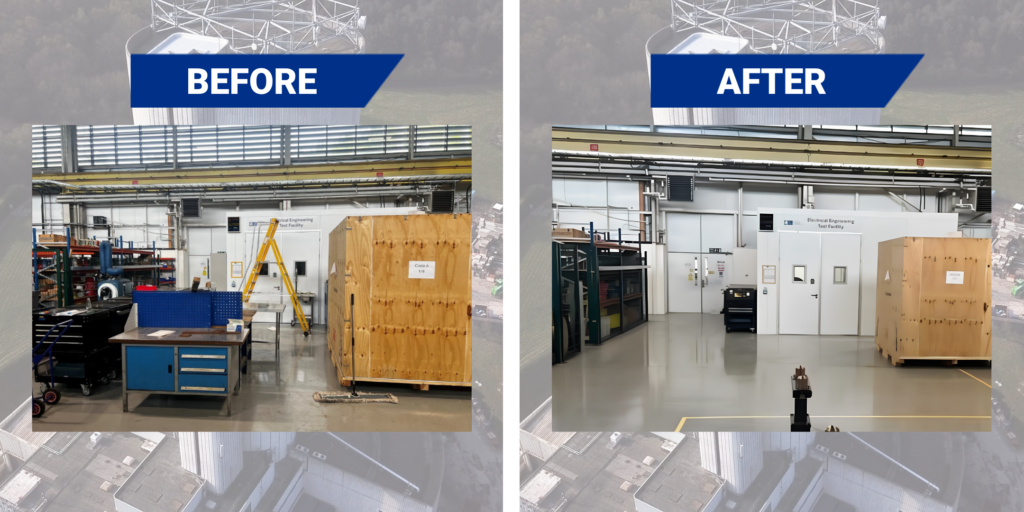
The ETC before and after the implementation of 5S.
Looking ahead, the team’s commitment to continual improvement extends beyond 5S. Training in approaches such as Lean Six Sigma, which focuses on reducing waste, improving processes and minimising defects, will help strengthen everyday practices and embed these changes further.
Together, these developments are creating a more efficient, consistent and focused environment, allowing the ETC to continue tackling complex and unique engineering challenges.