
Does the Weather see a Solar Eclipse?
20 Aug 2026
The 12th August 2026 marked the most complete solar eclipse for the UK in 27 years, with around 90% coverage of the Sun visible across the country.

A solar eclipse occurs when the orbit of the Moon around the Earth ends up passing in front of the Sun, causing a shadow to be cast on parts of the Earth. If the Moon only covers part of the Sun, this is known as a partial solar eclipse. This is what the UK experience last week where the Moon only covered 90-96% of the Sun depending on which part of the UK you were viewing from. When our view of the Sun is completely covered by the Moon, this is known as a total solar eclipse, with the last time this occurred for the UK being in 1999.
Solar eclipses are a visual spectacle, with people all over the country experiencing the dramatic event with their own eyes. But can a solar eclipse also be seen by the weather?
For almost the past 40 years, the Energy Research Unit (ERU), home to the Energy Data Centre at Rutherford Apple Laboratory (RAL), has been tracking weather data at the ERU Test Site. This weather data has included many parameters like rainfall and windspeed. However, there are two key measurements that are needed to see if this data can see the solar eclipse for itself, solar irradiance and temperature. Solar irradiance is the measure of the power per unit area received from the Sun by the Earth and ends up being a key factor of the energy input to the Earth, impacting our climate. This is measured with a Pyranometer that uses a photodiode to take these readings. Temperature is the result of this energy received and is measured by a Temperature Probe with a thermistor that takes readings of the temperature of the air at a set distance above the ground. If the solar irradiance is measurably lowered, we should expect to see temperature start to drop in turn.
As both of these measurements are dependent on the energy we receive from the Sun, if it is blocked by the Moon during an eclipse, our readings of these values will in turn be affected.
Looking back on the previous three solar eclipses the ERU has recorded weather data for since the ERU Test site became operational, we can see the impact these events have had on these measurements. Starting with the most recent eclipse from last week:
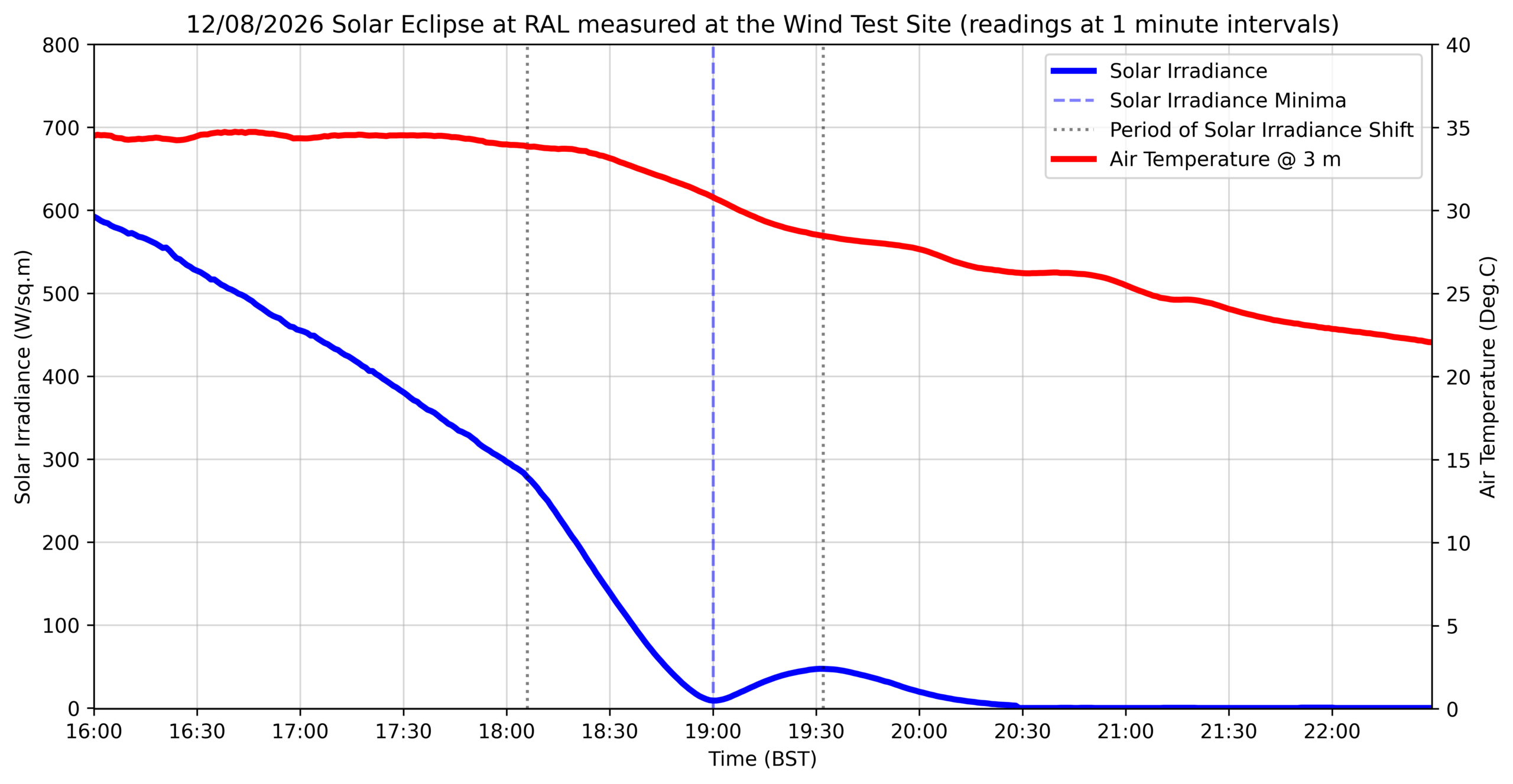
Solar Irradiance and Air Temperature readings taken at the ERU test site on 12/08/2026
The blue line here is solar irradiance, and the red is air temperature. This eclipse was quite different from the other two eclipses that the ERU has recorded, as this eclipse started in the evening as the Sun was setting, while the others had occurred before midday while the Sun was still rising. Because of this, both the solar irradiance and temperature were already decreasing by the time the solar eclipse began. The skies during this time were also very clear, leading the data to be much more stable than will be seen in the other readings.
At around 18:06 BST, the already decreasing solar irradiance appears to start decreasing at a faster rate, aligning roughly with the beginning of the eclipse in the area. This continued until 19:00 BST where the solar irradiance dropped as low as 8.96 W/m2. Due to the temperature already steadily dropping before the eclipse, a temperature change caused by the decreasing solar irradiance is not clear from this data, but the change in solar irradiance paints a picture as to the impact that solar eclipse had on these readings.
The next most recent eclipse that the ERU recorded data for is from 20th March 2015 that had a coverage of at least 83% for the whole UK, shown below:
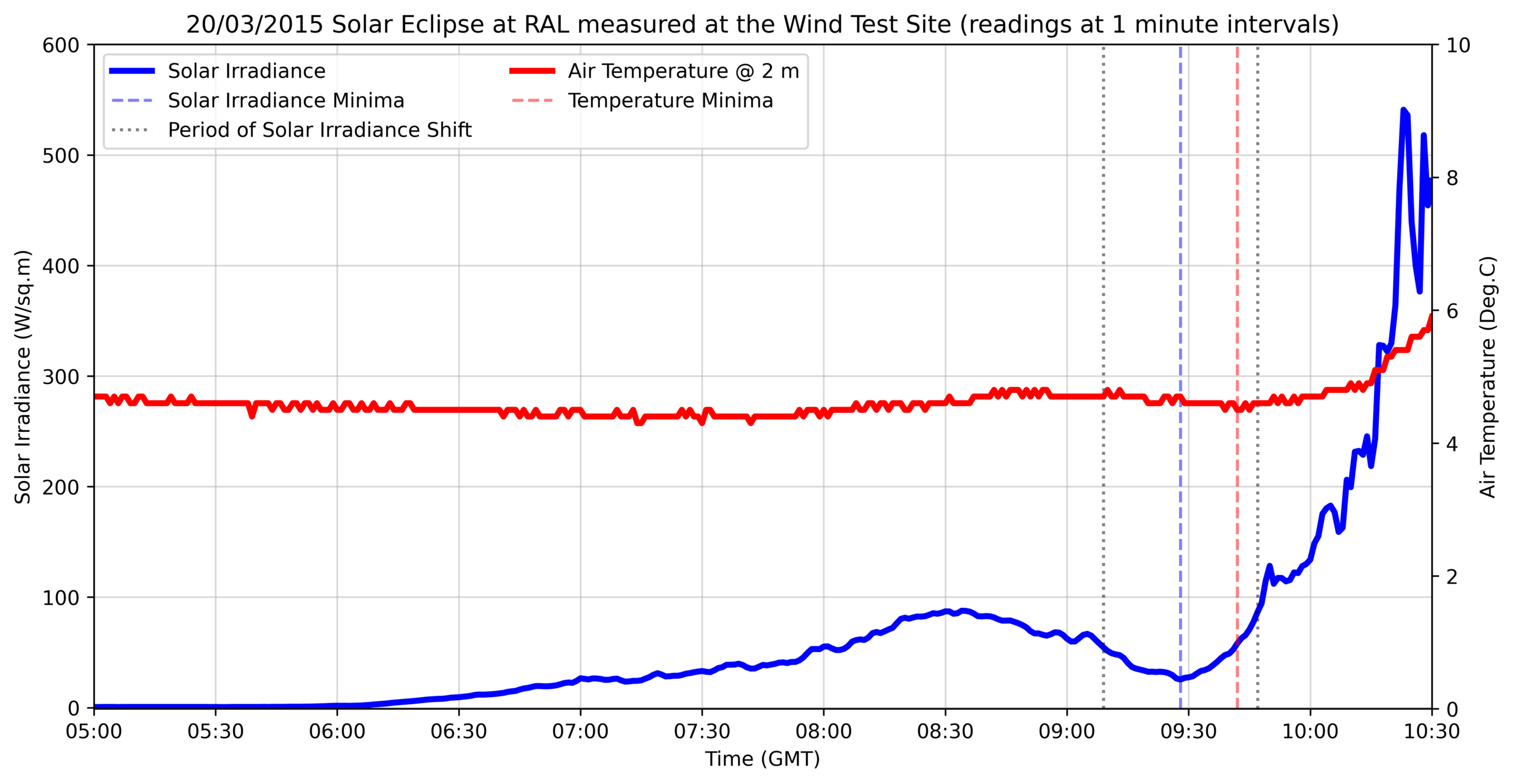
Solar Irradiance and Air Temperature readings taken at the ERU test site on 20/03/2015
As mentioned before, this eclipse occurred while the Sun was rising. Between the time of 8:30 – 9:30 GTM there is once again a noticeable decrease in solar irradiance, reaching a lowest value of 25.5 W/m2 at 9:28 GMT. These times also roughly line up with when the solar eclipse began at the time. [moonblink.info – 2015 Eclipse]
Following this, there is a very minor decrease in temperature that lags slightly behind the observed solar irradiance drop, before starting to rise again. This time lag between the minimum of solar irradiance and the minimum of air temperature was 14 minutes. The changes here are noticeable but quite subtle, due to the relatively low level of both these values during this period. If we are to observe how these measurements are impacted by a solar eclipse in more detail, we’ll need a day with higher values, as well as a stronger eclipse.
This brings us to the ERUs recordings from the solar eclipse on the 11th August 1999 which was the last time a total eclipse could be seen from mainland UK, shown below:
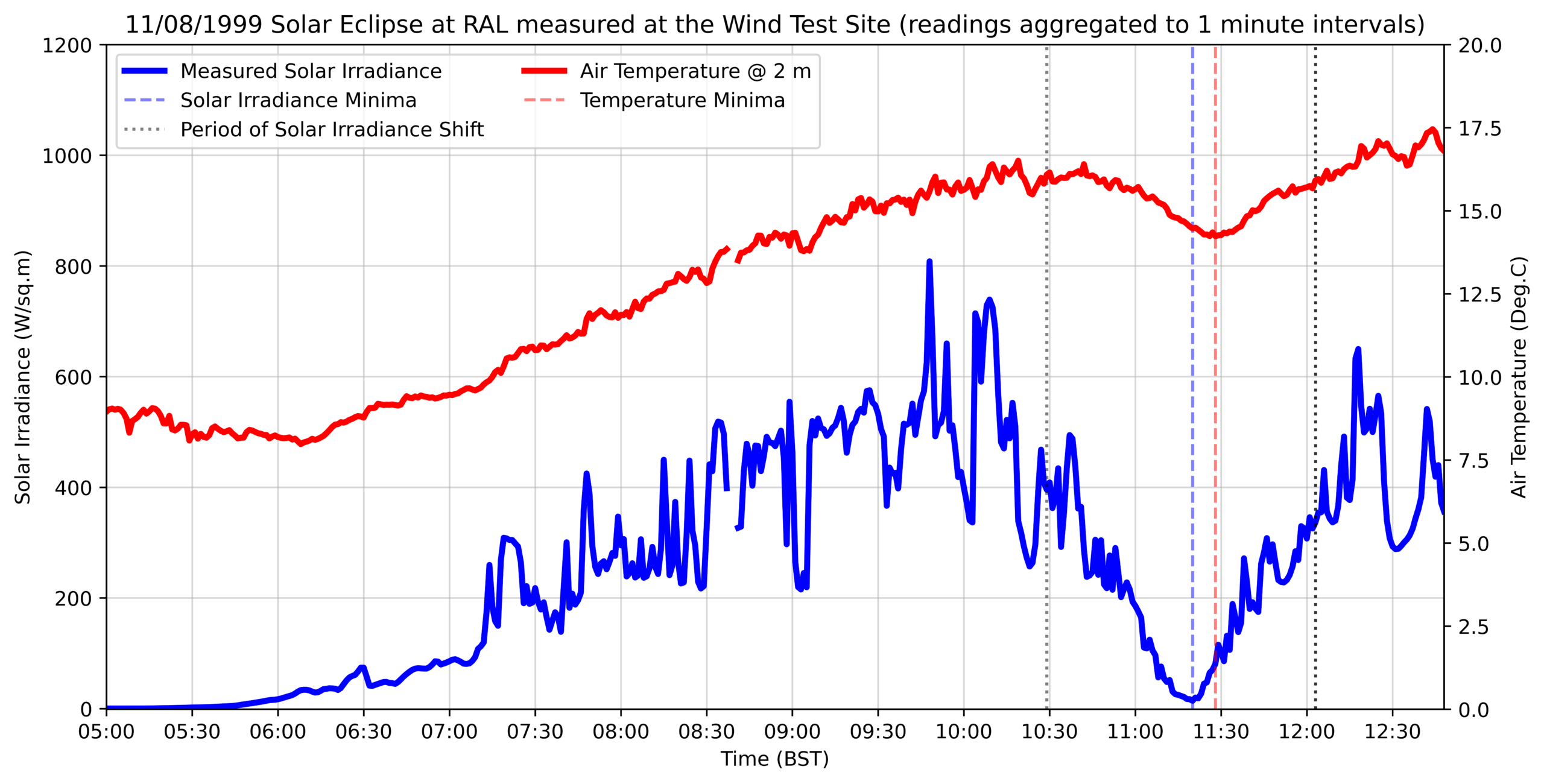
Solar Irradiance and Air Temperature readings taken at the ERU test site on 11/08/1999
Here there is a much larger decrease in solar irradiance, dropping from around 500 to only 14 W/m2. Although this was the last total solar eclipse that mainland UK has experienced, totality was confined mainly to Cornwall and Devon, with only a partial solar eclipse visible to RAL. This is why the minimum solar irradiance of this eclipse still ends up being higher than the one from last week. The period of decreasing solar irradiance starts at around 10:30 BST, matching recorded values of the start of the total eclipse [moonblink.info – 1999 Eclipse], and reaches its lowest point at 11:20 BST. This day was much cloudier than the other two days, leading to much more varied readings as the Sun was breaking in and out of cloud cover. Looking at the temperature change, there is a drop of around 2˚C that lags just behind the minimum in the solar irradiance by 8 minutes. This eclipse shows a clearer view of this reactive change in temperature that follows behind the dropping solar irradiance.
The recordings from these solar eclipses can demonstrate how these events impact weather measurements and how their monitoring the weather can help to paint the same story as what was observed with our eyes.
To celebrate this rare cosmic event last week, STFC hosted a public Stargazing event at RAL. The event started with a talk by Professor Richard Harrison on the science of solar eclipses, followed by a video-call with members of the British Antarctic Survey on board the RRS Sir David Attenborough in Greenland to witness a total solar eclipse.
There were many activities available to attendees to learn more about many topics around space and science, from making ice cream with liquid nitrogen to designing your own space instrument. This event provided a great opportunity to experience the eclipse, with attendees stood outside to see the solar eclipse with either eclipse glasses or through the multiple telescopes set up for some close-up viewing.
The video call with members of British Antarctic Survey on board the RRS Sir David Attenborough in Greenland
Attendees of the Stargazing event viewing the solar eclipse
Follow the links below to see more from the RAL Stargazing Event:
- STFC on LinkedIn – The most complete solar eclipse since 1999! 🌞
- STFC Technology Department on LinkedIn – 🌳 Did you know that you can use many different things as eclipse cameras? A cereal box, colander, even a tree!
Also follow the link below to learn how in 1999, RAL Space conducted a public citizen science campaign to see how the solar eclipse impacted radio waves:
The EDC team hopes you were able to safely enjoy the eclipse and are looking forward to the next total eclipse in 2090!
This blog was written by Oliver Brough and originally shared by the Energy Data Centre.